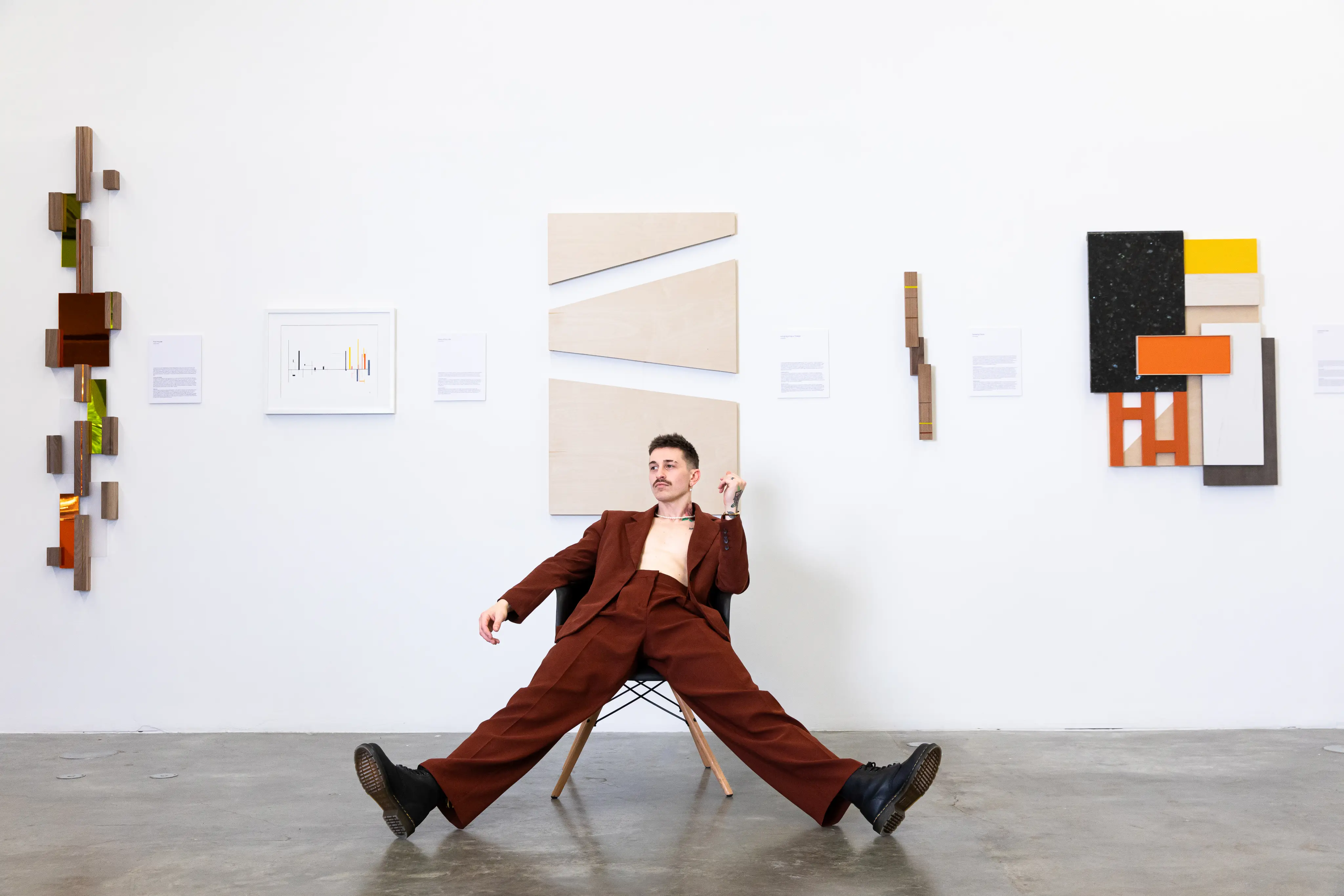
Who is she?
I make work that invites people to stay a little longer.
Not longer with an idea, longer with a life. A whole one. With flaws and dreams and trauma and baggage and ordinary Tuesday afternoons where nothing dramatic happens. Sometimes that life is mine. Sometimes it belongs to someone else entirely. But I always want you to see the human at the center of it. To feel their interiority. To recognize something on the other side. That's what stops me in front of someone else's work.
Being queer has always meant being hyperaware of my surroundings. Reading rooms. Scanning for safety. Over time, that survival instinct became something else. I walk into a room and my brain maps every variable: the sight lines, the silences, the way the light bounces among the walls. I've spent my whole life paying attention to details nobody else notices. The work is built from that.
The geometry in my work isn't a style I chose. It's how my brain works. It's how I get what's inside my head out into the world. The forms are simple. What they carry isn't. I play deliberately on the spectrum between abstract and literal, hiding things inside the work for people to find, inviting their own meaning in. And when you pair the work with my writing, something shifts. The dots connect. I love leaving things to find.
My father died by suicide in 2023. After that, like a Pandora's box, every repressed memory I had ever buried came back at once. I sat with my therapist week after week. We worked through each thing individually. Every fear, every fracture, every piece of grief I hadn't finished with yet, into physical form, onto a wall, for strangers. That is the Therapy collection.
When I started it, I went back into my own archives. What I found was hundreds of pages I'd written over the last fifteen years. Social psychology papers on heterosexism and its effects on queer people. Essays on how to be a better ally. Art I had made fifteen years ago with the explicit goal of making myself legible as a human being to people who didn't see me that way. I had been doing this my entire adult life. I just hadn't called it a practice yet. The grief didn't create any of this. It just finally made me stop apologizing for it.
At some point I understood that what I was doing had a name. I named it The Superpersonal. And once it had a name, I had to live by it. You can't preach radical vulnerability and then hold anything back. So I don't.
The Superpersonal is the driving philosophy of my practice. The belief that by fully humanizing yourself, surrendering your privacy, closing the distance between your interior life and the person standing in front of your work, you create the conditions for real empathy. Not performed empathy. The kind that actually shifts something. The chasm between people, especially between queer people and the world that misunderstands them, doesn't close through argument. It closes through feeling. Through recognizing a human being on the other side. I am happy to share everything about myself if it means I can make the world gentler for even a single young queer person.
My debut solo exhibition, 0,30: A Superpersonal Exhibition on Queer Survival, opened on my 30th birthday. I designed every variable: how people entered, where they paused, what they read and when. The playlist was every song I listened to while making the work. Nobody in the room knew that. They were inside my process without knowing they were inside my process. The experience is part of the art. It always has been.
I take what I do seriously. I do not take myself seriously. That tension is intentional. It's how I work, how I move through the world, how I've survived it.
I practice as a creative and exhibition director in contemporary fine art and museum spaces. I work from concept to smallest detail, my own collections and other artists' visions. I want to be the person who takes what lives in my head or someone's head and builds the channel that gets it out. I think obsessively about sequence, about story, about the moment a stranger stops mid-sentence in front of something and can't immediately explain why. I love to tell a story, and every exhibition needs a story.
I don't make queer art. I make art that is innately queer because a queer person made it. Everything I see, I see through that lens. But the invitation is for everyone.
Stay a little longer. That's all I'm asking.
Not longer with an idea, longer with a life. A whole one. With flaws and dreams and trauma and baggage and ordinary Tuesday afternoons where nothing dramatic happens. Sometimes that life is mine. Sometimes it belongs to someone else entirely. But I always want you to see the human at the center of it. To feel their interiority. To recognize something on the other side. That's what stops me in front of someone else's work.
Being queer has always meant being hyperaware of my surroundings. Reading rooms. Scanning for safety. Over time, that survival instinct became something else. I walk into a room and my brain maps every variable: the sight lines, the silences, the way the light bounces among the walls. I've spent my whole life paying attention to details nobody else notices. The work is built from that.
The geometry in my work isn't a style I chose. It's how my brain works. It's how I get what's inside my head out into the world. The forms are simple. What they carry isn't. I play deliberately on the spectrum between abstract and literal, hiding things inside the work for people to find, inviting their own meaning in. And when you pair the work with my writing, something shifts. The dots connect. I love leaving things to find.
My father died by suicide in 2023. After that, like a Pandora's box, every repressed memory I had ever buried came back at once. I sat with my therapist week after week. We worked through each thing individually. Every fear, every fracture, every piece of grief I hadn't finished with yet, into physical form, onto a wall, for strangers. That is the Therapy collection.
When I started it, I went back into my own archives. What I found was hundreds of pages I'd written over the last fifteen years. Social psychology papers on heterosexism and its effects on queer people. Essays on how to be a better ally. Art I had made fifteen years ago with the explicit goal of making myself legible as a human being to people who didn't see me that way. I had been doing this my entire adult life. I just hadn't called it a practice yet. The grief didn't create any of this. It just finally made me stop apologizing for it.
At some point I understood that what I was doing had a name. I named it The Superpersonal. And once it had a name, I had to live by it. You can't preach radical vulnerability and then hold anything back. So I don't.
The Superpersonal is the driving philosophy of my practice. The belief that by fully humanizing yourself, surrendering your privacy, closing the distance between your interior life and the person standing in front of your work, you create the conditions for real empathy. Not performed empathy. The kind that actually shifts something. The chasm between people, especially between queer people and the world that misunderstands them, doesn't close through argument. It closes through feeling. Through recognizing a human being on the other side. I am happy to share everything about myself if it means I can make the world gentler for even a single young queer person.
My debut solo exhibition, 0,30: A Superpersonal Exhibition on Queer Survival, opened on my 30th birthday. I designed every variable: how people entered, where they paused, what they read and when. The playlist was every song I listened to while making the work. Nobody in the room knew that. They were inside my process without knowing they were inside my process. The experience is part of the art. It always has been.
I take what I do seriously. I do not take myself seriously. That tension is intentional. It's how I work, how I move through the world, how I've survived it.
I practice as a creative and exhibition director in contemporary fine art and museum spaces. I work from concept to smallest detail, my own collections and other artists' visions. I want to be the person who takes what lives in my head or someone's head and builds the channel that gets it out. I think obsessively about sequence, about story, about the moment a stranger stops mid-sentence in front of something and can't immediately explain why. I love to tell a story, and every exhibition needs a story.
I don't make queer art. I make art that is innately queer because a queer person made it. Everything I see, I see through that lens. But the invitation is for everyone.
Stay a little longer. That's all I'm asking.
